
Payment orchestration has become one of the most talked-about topics in payments, and for good reason. Managing payments today means navigating a maze of processors, payment methods, and services like fraud prevention, and the more you scale, the more complex that maze becomes.
At some point, that complexity stops being an inconvenience and starts becoming a bottleneck. Maybe your engineering team is bogged down fixing payment issues instead of shipping core platform updates. Or your authorization rates are slipping with no clear fix in sight. Perhaps leadership is frustrated that enabling payments in a new market will take months, not days.
Whether you're already feeling these pain points or want to get ahead of them, you're here to explore payment orchestration. But with so many solutions claiming to offer it, how do you choose the right one?
The market is crowded, and the differences between providers can be subtle. But in payments, the devil is in the details, and those details can make all the difference.
Below, we cover five key considerations for selecting the right payment orchestration platform, compare the most popular options, and show how Primer—a Unified Payments Infrastructure with market-leading orchestration capabilities—can help you overhaul and optimize your payments stack.
Ready to take control of your payments? Discover how orchestration can simplify complexity, boost authorization rates, and unlock growth. Book a call with our team.
1. Does the platform offer the flexibility your business needs?
No two businesses have the same payment requirements, and the right platform should flex to meet yours, not the other way around.
The most obvious place to start is integrations: does the platform connect with all your critical payment services, processors, and fraud tools?
But flexibility goes well beyond that. It also means asking:
- Compliance: Can the platform adapt to the unique regulatory and compliance obligations of your industry and target markets?
- Checkout experience: Can you create checkout experiences that reflect your brand in a few clicks? And can you surface the most relevant payment methods and present them in the local language?
- Optimization: Does the platform give you the tools and data-driven insights to optimize for performance, cost, and risk?
- Routing workflows: Does the platform provide an intuitive interface for building, duplicating, and adjusting transaction routing rules without needing an engineer every time?
- Scalability: As your business grows, can the platform keep pace by letting you add new payment methods and processors without engineering overhead?
- System integrations: Can the platform share and ingest data from the other tools your business relies on, so payments doesn't become an island?
The last thing you want is to be locked into a provider's way of working. It's your business and your payments, you should be able to do what you need, without compromise.
2. Does the platform offer proprietary tools to improve payment performance?
Routing payments optimally across your processors and Payment Service Providers (PSPs) is the foundation of orchestration, but it shouldn't be the ceiling.
By sitting above all your payment services, a strong orchestration platform should offer proprietary tools that go further: helping you recover lost revenue, reduce friction, and squeeze more performance out of every transaction.
Look for tools that can:
- Recover declined payments using Fallbacks, so a failed transaction isn't necessarily a lost sale
- Unify the 3DS experience across all your payment flows, reducing friction for customers without compromising on security
- Route payments intelligently using real-time data and advanced routing logic, not just static rules
- Manage network tokens across your entire payments stack without writing a single line of code, simplifying token generation, application, and management while improving authorization rates and security
- Surface AI-powered recommendations so you can make smarter decisions about routing, performance, and optimization, without needing a data scientist to interpret the
These aren't nice-to-haves. The right orchestration platform should make them available out of the box, so your team can focus on what matters: unlocking the full potential of your payments.
3. Does the team behind the platform have the expertise to support your success?
Every orchestration provider should offer solid baseline support, if they don't, they won't keep customers for long. But where providers really differ is in customer success.
Payments are complex, and never stand still. Having an expert partner who proactively identifies optimization opportunities, keeps you ahead of changes in the ecosystem, and is genuinely available when you need them is worth more than most businesses realize until they don't have it.
When evaluating providers, ask about their approach to customer success, and ask for a reference call with a live customer to validate their claims. Talk is cheap; a customer who'll vouch for them isn't.
4. Does the platform offer advanced analytics capabilities?
Data is only useful if you can act on it. When evaluating an orchestration platform, look beyond the dashboard count and ask how the platform actually helps you understand and improve your payments day to day.
Look for a platform that can:
- Trace every transaction across all regions, payment methods, and processors.
- Monitor approval rates at a granular level, so you can pinpoint underperformance and fix it fast.
- Detect anomalies early before a dip in performance becomes a serious problem.
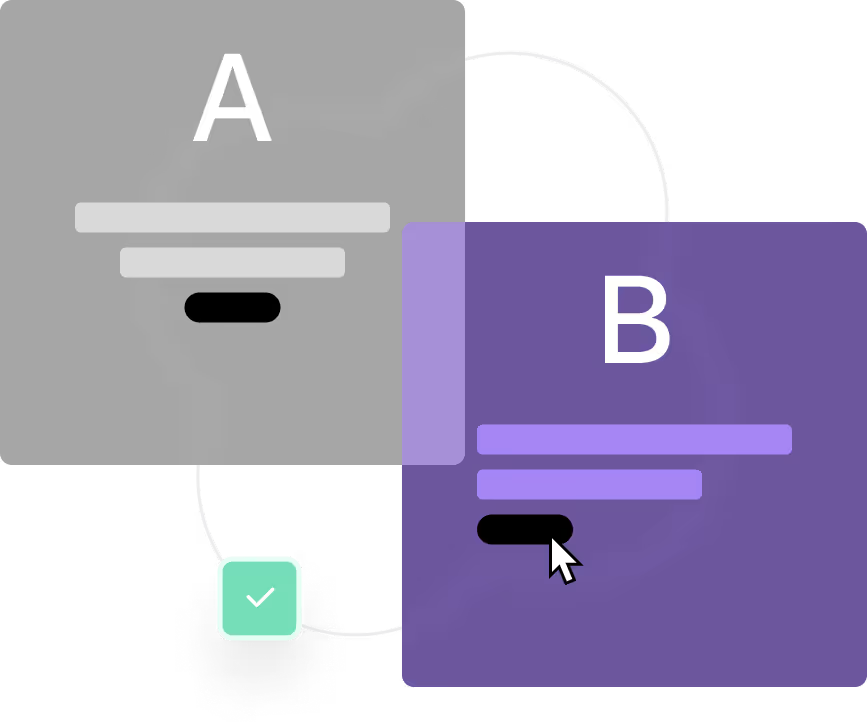
- Run A/B tests on routing strategies without pulling in engineering every time
And increasingly, the best platforms go further, putting the power of an AI payments expert directly in your hands. Instead of waiting on a report or digging through dashboards, you can query your data in plain language, get intelligent recommendations, and move at the speed of an entire payments team.
5. Does the platform add value beyond payments?
The best orchestration platforms don't just solve payment problems, they create value across your entire business. As payments leaders take on a more strategic role, it's worth asking how your platform can extend its reach into other teams and workflows.
Some platforms let you integrate third-party business tools directly into your payment flows, turning your payments infrastructure into a coordination layer for the whole organization.
That might mean automatically creating a support ticket when a high-value customer hits a payment failure, giving your finance team a single place to reconcile transactions across every processor and currency, or managing FX conversions without jumping between tools.
The question to ask isn't just "what can this platform do for payments?"; it's "what can this platform unlock for the rest of my business?"
Learn more: Your ultimate payment orchestrator buyer’s guide
Why consider using Primer for payment orchestration?
Primer gives you the freedom to consolidate and manage all your payment services through a single platform.
From connecting local and global processors to adding new payment methods to building complex payment routing workflows, it all happens in one place with no code required.
But Primer isn't just a payment orchestration platform. It's unified payments infrastructure, built to give you complete control over every transaction and full visibility from checkout through to settlement.
Whether that's optimizing performance with AI-powered tools, automating reconciliation, or managing funds across Global Accounts, Primer gives your payments team and your finance team the tools they need to move faster and operate smarter.
And as your business grows, Primer scales with you—into new markets, new payment methods, and new levels of complexity—without the re-integrations and rebuilds that hold most businesses back.
Here are some of the reasons leading merchants, including GetYourGuide, Conforama, Dabble, Ferryhopper, Eldorado, Printify, AppsFlyer, and Maisons du Monde use Primer.
Optimize performance and cut costs with smart routing
Effective payment routing can make a real difference to your bottom line. But implementing even the simplest routing rules typically requires significant engineering resources and constant fine-tuning to keep performance where it needs to be.
Primer pioneered the no-code workflow builder for payments, and Workflows remains the most powerful way to take control of your routing without a single line of developer input.
Using an intuitive drag-and-drop interface, you can set up and automate rules that guide every transaction along the most effective path, based on any combination of performance data, cost, region, payment method, processor, currency, customer segment, and more.
Within Workflows, you can also:
- Set up Fallbacks to automatically route failed-but-recoverable transactions to a backup processor in real time, so no revenue slips through the cracks.
- Execute your 3DS strategy across all payment flows, giving you control over when and how authentication is triggered.
- Run fraud checks by connecting your preferred fraud tools directly into the payment flow, so every transaction is assessed at the right moment.
And that's just scratching the surface. Whatever your payment flow needs to do, Workflows gives you the flexibility to build it, without waiting on your engineering team.
Learn more about Primer Workflows.
Effortlessly integrate with payment processors and add new payment methods
As your business grows, so does the complexity of managing payment processors and payment methods across different markets. What starts as a manageable stack can quickly become a bottleneck.
Primer solves this with a single unified API that gives you access to a broad network of global and local processors and payment methods, with no additional code required. Adding a new processor or payment method takes minutes, not months:
- Choose the processor you want in the Primer Dashboard
- Grant Primer access to your processor account
- Select any payment methods you want to enable for that processor
- Configure when and how those payment methods appear for your customers in Primer Checkout
That speed of integration was critical for Dabble, a social betting app expanding rapidly in Australia's competitive betting market. They needed to move fast, adding new payment methods and processors to meet customer expectations and regulatory requirements, without disrupting what was already working.
With Primer, Dabble quickly integrated Apple Pay and Google Pay for a frictionless checkout experience, and onboarded multiple new processors, including Nuvei and Checkout.com, to build redundancy into their stack and dynamically route transactions for optimal performance.
.png)
Read more: Dabble picks a winner by partnering with Primer
Gain actionable insights across all your payments
Primer's Observability gives you a single, real-time view across your entire payment stack, so instead of reacting to problems after the fact, you can spot and resolve them before they escalate.
With over 100 visualizations, you can track acceptance rates, transaction trends, and regional performance at a granular level. That means identifying which payment methods are underperforming, where abandonment is happening, and which processors are dragging down your authorization rates, then acting on it.
And with Monitors, you don't have to be watching the dashboard to stay on top of things. Set automated alerts for sudden drops in approval rates or transaction volumes, and get notified instantly—via email, webhook, or Slack—so you can respond before a dip becomes a problem.
.png)
But visibility is only half the picture.
Primer's AI Companion goes further acting as an intelligent payments expert built directly into the platform. Instead of digging through reports or waiting on analysis, you can ask questions in plain language, surface optimization opportunities instantly, and get recommendations that help you act faster and smarter across your entire payments operation.
Manage global funds and automate reconciliation
As your business scales across multiple processors, currencies, and markets, reconciliation becomes increasingly complex. Finance teams end up manually exporting and comparing transaction and payout reports from different processors, normalizing inconsistent data formats, and chasing down discrepancies.
It's time-consuming, error-prone, and a drag on financial reporting.
Primer Reconciliation cuts through this by consolidating transaction, payout, and settlement data from all connected payment providers into a single, standardized view, so your finance team spends less time on manual admin and more time on work that matters.
Global Accounts take this further. Merchants can collect, hold, and move funds globally through a unified account structure, receiving funds in multiple currencies, managing balances centrally, and controlling how and when funds are converted or transferred. No more fragmented PSP infrastructure or reliance on multiple banking relationships to do what should be straightforward.
Together, Reconciliation and Global Accounts give your payments and finance teams a single source of truth, full visibility over payment performance and the movement of funds, so you can operate global infrastructure with confidence.
How Maisons du Monde uses Primer to make payments a growth lever

Maisons du Monde, a leading European home decor brand operating in 11 countries, was hitting a wall. As its ecommerce operations expanded, integrating new payment methods and processors was becoming a bottleneck, slowing growth and placing an increasing burden on its technical teams.
"Integrating just one payment method takes us a few months, meaning we can't scale anywhere near as fast as we want," explains Jérémy Lechardeur, CTO Direct to Consumer at Maisons du Monde. "That's not to mention the challenges we have with operational tasks like reconciliation, now that we're accepting multiple payment methods and using multiple payment processors."
With Primer, Maisons du Monde removed those bottlenecks. The team could integrate new payment methods and processors quickly, without the technical overhead that had held them back. By offering payment methods tailored to each market's preferences, they reduced cart abandonment, improved customer satisfaction, and increased conversion rates across Europe.
Primer's Observability also gave the team deep visibility into processor performance and transaction trends, empowering them to optimize payment flows, adjust routing strategies, and uncover new growth opportunities without additional development resources.
The result: payments transformed from an operational hurdle into a strategic growth enabler.
%20(1).png)
Primer: more than just payment orchestration
Primer gives you everything you need to accept, optimize, and manage payments at scale, from advanced routing and fallbacks to real-time observability, automated reconciliation, and global fund management.
It's a platform built for payments teams and finance teams alike, giving your whole business the freedom, flexibility, and control to grow without limits.
%20(1).png)
Frequently Asked Questions (FAQ)
What is a payment orchestration platform?
A payment orchestration platform sits between your checkout and your payment providers, acting as a control layer that connects multiple processors, payment methods, fraud tools, and services through a single integration. It allows businesses to manage routing logic, analyze payment performance, and optimize transactions without building and maintaining separate integrations for every provider.
When should a business consider using payment orchestration?
Businesses often start considering payment orchestration when their payment stack becomes difficult to manage. Common signs include declining authorization rates, heavy engineering involvement to add payment methods or processors, slow expansion into new markets, and limited visibility into payment performance across providers. Orchestration helps simplify this complexity while improving performance and scalability.
What should you look for in a payment orchestration platform?
Key factors include the breadth of integrations with PSPs and payment methods, the flexibility to customize routing and payment flows, strong analytics and reporting capabilities, and tools that improve payment performance such as smart routing, fallback logic, and authentication management. It’s also important to evaluate how easily the platform can scale with your business as you expand into new markets or add new payment providers.

%20(1).png)