Payment Orchestration Solutions for GCC Businesses
If you're expanding across the Gulf, you’ll know that each market needs its own payment methods, acquirer connections, and compliance setup. If your engineering team is building those integrations one at a time, the payment stack becomes the bottleneck to market entry when you’re trying to expand.
Without a platform sitting between the merchant and its processors, every new market means months of integration work.
A payment orchestration platform can help you manage connections across these markets from a single integration. Here are the platforms worth evaluating:
Primer
Since we're writing this article, we'll start by telling you about ourselves first.
Primer is a Unified Payment Infrastructure that connects merchants to multiple processors through a single integration.
Primer supports several of the methods that matter in the region, which can be added to your checkout in a few clicks:
- Apple Pay and Google Pay: The most widely used digital wallets across both Saudi Arabia and the UAE. In Dubai, card-linked wallets now cover over 60% of preferred ecommerce payments.
- nol Pay: The UAE's growing payment method, supported directly through Primer.
- PayPal: Widely used across the GCC for cross-border transactions.
In addition to having built-in integrations for some of the GCC’s preferred payment processors, Primer can help manage the layer above individual payments. Here’s how:
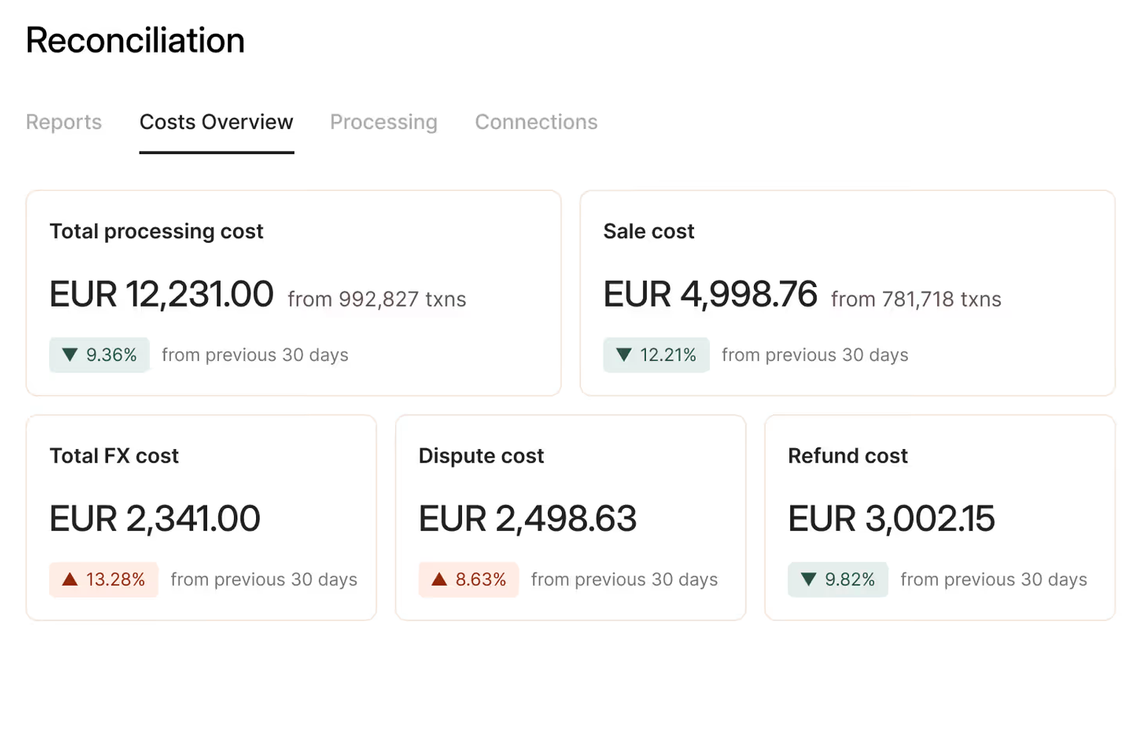
- Routing between processors: Workflows let you set up payment routing rules by market, card type, or transaction value without code to optimize payment processing. All with no-code, using intuitive drag-and-drop. Comparing costs: Costs Overview pulls settlement data from every connected processor into one format, so you can see what each one is charging across your GCC markets without reconciling separate reports.
- Tracking authorization rates: Observability shows how each processor is performing by market, card type, and payment method, so you can spot underperformance and adjust routing.
- Settling in local currencies: Global Accounts provides local currency accounts in 20+ countries without requiring a legal entity, including SAR, QAR, and BDH. This reduces the FX markup your PSP charges on every cross-border conversion.
"Global Accounts gives you a local account in the local currency of the country that you're selling in... without having to go and open a legal entity. That means better control and transparency over your FX, lower costs because our rates are more competitive than the PSPs, and consolidation of all your currencies in one place." — Ali Al Bajati, Product Manager at Primer
Other payment orchestration solutions for GCC businesses
- Yuno opened Middle East operations as part of its Series B expansion, partnering with Invest Qatar.
- PayTabs is another option headquartered in Saudi Arabia.
- Spreedly is a US-based orchestration platform that also operates in the Middle East.
How to scale payments across the Gulf with Primer
Primer removes the engineering bottlenecks from expanding across the Gulf.
You can:
- Activate local payment methods and processors from a dashboard without any coding.
- Use Workflows to route transactions to your preferred acquirer (based on parameters you decide), so authorization rates improve and cross-border fees drop.
- Global Accounts lets your merchants collect in local currencies without opening a legal entity in each country.
- Compare cost and performance across every processor, replacing manual report reconciliation using Costs Overview.
Book a demo to see how Primer handles payment method activation, multi-market routing, and local currency collection across the GCC.
Frequently asked questions (FAQs) about payment orchestration in the GCC
What's the difference between a payment orchestration platform and a payment gateway in the GCC?
A payment gateway processes transactions with one provider. An orchestration platform sits between you and multiple providers, letting you route transactions, manage fallbacks, and compare costs across processors from one integration. In a region where each market has different payment preferences and acquirer dynamics, orchestration reduces the engineering cost of supporting multiple markets.
Can you collect in local GCC currencies without a legal entity in each country?
Traditionally, collecting in local currency could require a local bank account, which requires a local legal entity. Some orchestration platforms, including Primer through Global Accounts, offer local currency accounts without the legal entity requirement.
%20(1).png)